

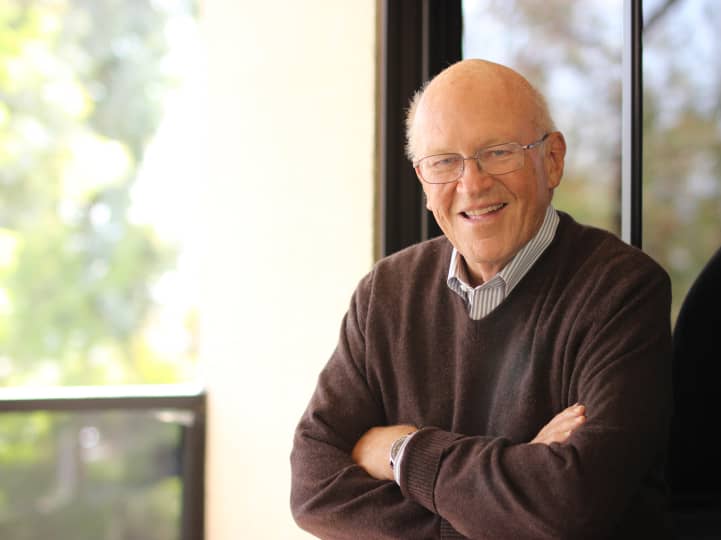

Nicholas Hill
Ken Blanchard! Welcome. It is good to have you with us today!

Ken Blanchard
Oh! It is my joy to be with you.
Nicholas Hill
It is a pleasure. In 1982 together with Spenser Johnson, you co-wrote the book, The One Minute Manager, which is now in its 10th edition, having sold over 13 million copies today. For those readers of Managerial Magazine, who have never read the book, God forbid, please give us the core message of The One Minute Manager.
Ken Blanchard
The book is a parable about a young man searching for an effective manager because he wants to work for one and be one. We wrote a parable because Spenser was a children’s book writer. He wrote values-based tales like the value of curiosity – the story of Christopher Columbus, the value of honesty – the story of Abraham Lincoln and a bunch of stuff like that. I am a storybook teller. We met at a cocktail party in 1980. My wife and I said if you two wrote a children’s book for managers, they wouldn’t read anything else. So that was the motivation. But the basic concept is that we believe that the 20% will give you the 80% as a manager. His three secrets which we talk about in The One Minute Manager; the first one is One Minute goal setting. All good performances start with clear goals. If people don’t know what you want to do, there is little chance of enjoying it. Once you have clear goals, you need to wander around, see if you can catch them doing something right, and give a One Minute praise, which is telling what they did, and how you feel about it, encouraging them that they keep up the excellent work. And then, if they make a mistake or their performance is not at par, to know what they did, you give them a One Minute reprimand, which tells them what they did wrong, how you feel about it, and what they need to do to get back. So those were three secrets. When a man recently came up to me and said, “My dad gave me that book when I was at a college, and his father gave him the book when he was at a college. So we are still working on three or maybe four generations.
Nicholas Hill
Sure. And you recently released the book, The New One Minute Manager, so how has the book changed since The One Minute Manager came out about 30 years ago?
Ken Blanchard
It is interesting. We had never got an e-book of The One Minute Manager, so they were interested in doing that. They said you want to read it to see if there is any change. I was also coming out with a book, Be Fired! Don’t Retire. Make the rest of your life the best of your life. So I thought maybe The One Minute Manager needs to re-fire. We laughed when Spenser and I read the book because many things had changed. One of the biggest ones is technology. In the original One Minute Manager, he used to have an intercom system on touch. Everybody working with him is gathered right around him. So he is not managing anybody online or anybody at a distance. Another thing we noticed was that all of it, consistent in the 1980s, was a kind of command and control of leadership. He was setting the goals. He was deciding whom to praise and reprimand. So we thought management and leadership were more side by side and all about partnership. So we changed the whole tone of the book. It is more participative and collaborative. The most significant change is that we changed One Minute Reprimands to One Minute Redirects in a preventer approach.
Nicholas Hill
Yes, I read that when I was going through the book, how you changed One Minute Reprimand to One Minute Redirect. So please explain the distinction between the two for those who don’t know the difference.
Ken Blanchard
Well, the distinction is that now you redirect when you see a performance problem. You can only see a performance problem if you have done excellent one-minute goal setting because all reasonable goals have to be observable and measurable to observe over time. What often happens with people is that they only get feedback when they get an annual performance review. That is ridiculous.
Nicholas Hill
And those reviews can also be daunting for some people
Ken Blanchard
Yes, we feel that praising, and redirections are all part of coaching. And so, if the performance is not moving in the direction you both had agreed upon when you did goal setting, you can go and say, I am looking at the data, and it is not what we wanted. Do you see the same thing? You now collaborate to ensure that you are both talking about the same thing. What can we do to get you back on track and redirect your energy? So, it is much more like a collaborative performance, but you are also not letting the performance go by the wayside because you caught it early, knowing it worsens later.
Nicholas Hill
Sure. How would you say the new manager’s leadership style compares to executive coaching?
Ken Blanchard
Well. I think it is very similar. The One Minute Manager is a good framework for executive coaching because you always want to start by saying what you want to accomplish. How will you know when you get there? What does good performance look like? Then the coach, in many ways, praises progress. Since we last talked, you have made some good progress. How do you feel about it? And then you say, I am working for you, but it seems I am not making the kind of progress you wanted. What can I do to help you to get on track? Again as I said, those three things are the 20% that will give you the 80% of the results you want when you are coaching and even managing.
Nicholas Hill
So, while using these coaching questions, you make sure you are cutting to the chase and using the 20% to get your 80%.
Ken Blanchard
Yes. And that’s why you want to ensure that your goals relate to SMART goals. You heard that acronym to start with specific and measurable that is S and the M. It sums up the essence of goal setting. Next, it has got to be attainable, realistic and time-bound.
Nicholas Hill
Regarding the three secrets to One Minute Management, how would you say this compares to the oversimplification of the feedback sandwich?
Ken Blanchard
Well. The whole concept of feedback is that you want to ensure that people understand what is happening. The sandwich is that you are supposed to say something good, then say something negative, and then end with a positive. We don’t believe that it always works. If you are going to redirect, you will not start with the praising. You are starting with an observation that your performance is not moving in the direction we both agreed. Is that what you see too? And at the end of the whole thing, you say I still have confidence in you. So you want to end it with a positive. But I don’t think we always have to have a positive, then a negative, and then a positive formula.
Nicholas Hill
Using your redirect formula, which parts are more critical than others?
Ken Blanchard
If you don’t do the goal setting well, you can’t do the last two. If I was going to say, what is the foundation of the whole thing? It is goal setting. Then we find that we are talking about situational leadership or anything in our work. All good performance starts with clear goals. Clear goals start the whole process and set up redirections and praise. As Drucker said years ago, if you can’t measure something, you can manage it. So it’s got to be observable and measurable.